Guide
Basics
Dec 12, 2025
VAT in the United Arab Emirates: rules, thresholds, and obligations for businesses
VAT rates applicable in the United Arab Emirates
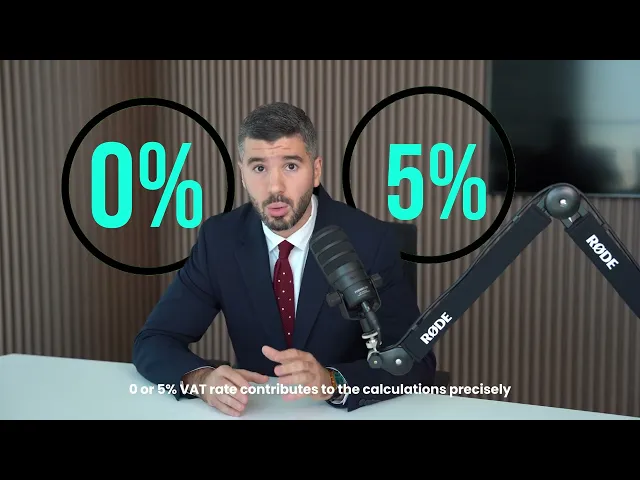
The United Arab Emirates apply only two VAT rates:
a standard rate of 5%,
a zero rate for certain specific transactions.
Both rates are taken into account when calculating the VAT registration thresholds, which means a business may be required to register even if part of its transactions are taxed at 0%.
In addition, there are two specific regimes:
exemption, where the transaction is not subject to VAT, and exception, which applies to specific cases provided for under the regulations.
When is a business required to register for VAT?
Two thresholds determine whether VAT registration is mandatory or optional:
Mandatory threshold
A business is required to register for VAT once its taxable turnover exceeds AED 375,000. Crossing this threshold triggers a mandatory registration obligation within the timeframe set by the Federal Tax Authority.
Optional threshold
A business may choose to register voluntarily if its turnover reaches AED 187,500.
This option is particularly useful for companies that want to recover VAT on their expenses or enhance their commercial credibility.
Note: transactions taxed at 0% are included in both thresholds.
Cases where a business is considered “outside the scope” of VAT
Certain transactions fall outside the scope of UAE VAT because they have no territorial connection with the United Arab Emirates.
A typical example is a company that purchases goods in China and resells them in Côte d’Ivoire, without the goods ever passing through the UAE.
In this case, the business is considered outside the scope of VAT:
it is not required to register, file VAT returns, or apply any local VAT rate.
Understanding this concept is essential for companies involved in international trade or goods flows that do not involve the UAE.
VAT returns: frequency and obligations
Once registered, a business must file a VAT return on a quarterly basis.
This return includes:
the amount of VAT collected on sales,
the recoverable VAT on purchases,
the net balance payable or refundable.
Meeting filing deadlines is essential, as the UAE applies a strict tax compliance regime.
Penalties for late registration or failure to register
The most heavily penalized violation is failure to register for VAT, which can result in a fine of up to AED 10,000.
Late filing or late payment also leads to penalties, calculated based on the amount due and the length of the delay.
VAT registration and filings should therefore be anticipated in order to avoid any administrative sanctions.
table of contents
Ready to take the next step?
© 2025 Daftime